


Towards strengthening the pharmaceutical system in conflict-affected areas in Mali
.png)

Project overview
In conflict-affected areas of Mali, access to quality medicines and their rational use are severely compromised. The informal sector, the main source of supply, exposes populations to products of dubious quality and excessive use of antibiotics and injectables, exacerbating health risks.
Project solution
This project offers [specific solution or intervention] to tackle [challenge]. By implementing [strategies, tools, or innovations], the project aims to achieve [desired outcomes]. The approach is designed to [specific actions or methods] to bring about meaningful change in [community, region, or issue area].
Expected outcomes
This project aims to achieve [specific outcomes], such as [measurable results, improvements, or changes]. The expected impact includes [benefits to the target community, advancements in research or innovation, or long-term effects]. By the end of the project, we anticipate [specific changes or milestones] that will contribute to [broader goals or objectives].
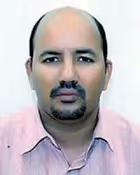
Mohamed Ali Ag Ahmed
FMOS Bamako
Generating and making available knowledge on the functioning and performance of the pharmaceutical sector in conflict areas is an essential prerequisite for stakeholders to be able to identify plausible interventions for making quality and affordable medicines available to health care users.
Principal Investigators: Mohamed Ali Ag Ahmed, MD, MPH, PhD (PI), Issa Coulibaly, PharmD, PhD (Co-PI)
Research Snapshot: Pharmaceutical supply chains in conflict-affected Mali
In conflict-affected areas of Mali, access to quality medicines and their rational use are severely compromised. The informal sector, the main source of supply, exposes populations to products of dubious quality and excessive use of antibiotics and injectables, exacerbating health risks.
[.cta_link]Read the snapshot - English[.cta_link]
[.cta_link]Read the snapshot - French[.cta_link]
What did the study set out to achieve?
The World Health Organisation highlights the availability and ‘rational use’ of medicines as a major global health challenge. Rational use refers to correct prescription and dispensation of medicines, as well as patients taking them as prescribed. Conflicts, such as that affecting Mali since 2012, disrupt the pharmaceutical sector, and create additional barriers to drug access and rational use. Improving availability and access to drugs, and rational use, requires understanding of challenges and barriers.
This systemic, mixed method study began with a scoping review to analyse functioning of the pharmaceutical sector in conflict settings. Medicines availability in Mali was assessed using data on 38 drugs in 59 health facilities, supplemented by 28 interviews with key stakeholders. Medicine use was analysed based on 789 prescriptions of 443 patients, and 20 stakeholder interviews.
What were the key findings?
This study analysed the pharmaceutical supply chain, and use of essential medicines, in conflict-affected Mali. It found multiple barriers to availability, access, and ‘rational use’ of medicines, driven by staff shortages, limited training and supervision, insecurity, and delayed access to care, with a wide reliance on the informal sector to supply medications. Strengthening training, oversight, access to guidelines, and community awareness, alongside innovations like telemedicine, is essential to improve medicine availability and rational use and improve the quality and safety of medicines. Follow-up work is underway in collaboration with Mali’s health authorities to advance rational and safe medicine use through various strategies.
- Multiple barriers to accessing quality medicines were found, including shortages and logistical delays. Local actors have developed various coping mechanisms to overcome these.
- Essential medicines availability was 73% overall- below the WHO’s 80% target. Public‑sector availability was 69%, while the private sector met the target (80%). Prices far exceed international benchmarks, limiting their accessibility. The main source of supply is the informal sector.
- Widespread irrational use of medicines was found, including overuse of antibiotics and injectables, and polypharmacy (too many medicines per patient). Medicines not included on the national essential medicines list were often prescribed.
- Factors driving these practices are both individual and systemic; and are closely interconnected: including health worker shortages, heavy workloads, skills and supervision gaps; insecurity, pressure from armed groups, administrative weaknesses and delayed patient access to care. Some stem directly from the conflict: others have been exacerbated.
What does this mean for policymakers and practitioners?
The dependence of the pharmaceutical system on the informal sector stems from the underlying weakness of the health system, and disruptions driven by conflict and insecurity. This supply source raises concerns about quality and safety of medicines. These factors highlight the urgent need to strengthen the rational use of medicines and to work towards effective Universal Health Coverage. Sustainable strengthening of pharmaceutical systems in conflict-affected areas requires coordinated, adaptive strategies, rooted in local realities. Malian health authorities and partners could:
- Support a coordinated multi-stakeholder plan to address medicine availability and rational use.
- Initiate activities to promote the rational use of medicines, such as continuing education, performance management of health personnel, and public awareness campaigns on the risks of street drugs and self-medication.
- Adapt certain technological advances in medicine to conflict zones, such as telemedicine, which could advance rational use of medicines and efficient management.
The study team are working with local stakeholders including healthcare providers and the Ministry of Health to advance training, partnerships, and further research to address the issues identified.
Project delivery & updates
Stay up to date with the latest developments from this project. Here, you will find details on what has been delivered, resources created, and regular updates as the project progresses. Access key documents, reports, and other materials to see how the project is making an impact.
Resources
Journal article
LEARN MOREResearch snapshot
LEARN MORE