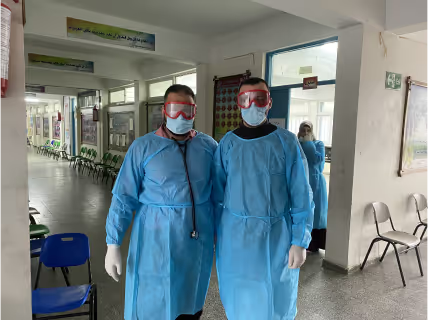


Participants’ Research Ethics Toolbox (PRET) for the mpox response


Project overview
This project involves training research stakeholders in the Democratic Republic of Congo (DRC) on use of the Participants’ Research Ethics Toolbox (PRET), to support potential research participants’ understanding and assertion of their rights in the current Mpox emergency and beyond.
Countries
Democratic Republic of Congo
Organisations
Western University
Partners
National Health Research Ethics Committee (DRC), Congo Network of Religious Leaders living or personally affected by HIV and AIDS (CONERELA+), Centre for Applied Ethics, University of Kinsasha, Humanitarian Health Ethics Group, World Health Organization, Fondation Santé et Développement Durable (Guinea)
Area of funding
Humanitarian Research
Grant amount
£44,972
Start date
01
January
2025
End date
30
September
2025
Project length (in months)
9 months
Funding calls
Focus areas
No items found.
Topics
Communicable diseases
Ethics
Mpox
Status
Closed
Project solution
This project offers [specific solution or intervention] to tackle [challenge]. By implementing [strategies, tools, or innovations], the project aims to achieve [desired outcomes]. The approach is designed to [specific actions or methods] to bring about meaningful change in [community, region, or issue area].
Expected outcomes
This project aims to achieve [specific outcomes], such as [measurable results, improvements, or changes]. The expected impact includes [benefits to the target community, advancements in research or innovation, or long-term effects]. By the end of the project, we anticipate [specific changes or milestones] that will contribute to [broader goals or objectives].

Elysée Nouvet
Western University
It is in discussing negative experiences of Ebola research with Ebola survivors that the idea for this Toolbox emerged. This is a project about strengthening the conduct of ethical research in public health emergencies, with a focus on equipping members of affected populations with practical understanding and strategies to navigate invitations to research and assert their rights as research participants.
What did the study set out to achieve?
The study aimed to build capacity for ethical research conduct in the Democratic Republic of Congo (DRC) by training community leaders, research stakeholders, and ethics committee members on the Participants’ Research Ethics Toolbox (PRET).
The PRET is an open‑access set of tools that includes videos, posters, and discussion activities. It was originally developed in collaboration with Ebola survivor groups following the 2014 to 2016 Ebola outbreak and is designed to support adults with limited literacy to understand research processes, consent considerations, and research participants’ rights.
In this study, PRET was applied in the context of Mpox‑affected communities. The study objectives included delivering train‑the‑trainer workshops, supporting community leaders to lead PRET‑based discussions in their own contexts, and disseminating PRET among researchers and research governance stakeholders involved in public health emergency research.
What were the key findings?
Two in‑person train‑the‑trainer workshops were delivered in Kinshasa in June 2025, involving 40 community and religious leaders affiliated with the CONERELA+ network.
Participants completed post‑workshop questionnaires and provided verbal feedback during facilitated sessions. The feedback indicated increased self‑reported understanding of research participants’ rights, differences between healthcare and research, and processes related to research participation.
Participants also reported feeling able to use and share PRET materials within their communities.
Feedback from workshop participants informed the development of additional PRET resources. These included a research participant commitments poster, workshop planning materials, and the scripting of an additional video explaining why Mpox vaccine trials are conducted.
Dissemination activities included an in‑person orientation to PRET at the University of Kinshasa involving approximately 100 research trainees and research governance stakeholders, as well as conference and virtual presentations with regional and international research actors.
[.cta_link]read blog[.cta_link]
What does this mean for policymakers and practitioners?
The study provides an example of how PRET was used within training and dissemination activities involving community leaders, researchers, and ethics governance stakeholders during a public health emergency.
Activities included engagement with national ethics stakeholders in the DRC, including members of the National Health Research Ethics Committee, in relation to awareness and potential future use of PRET within ethics training and engagement processes.
The study also documented that community leaders trained through the train‑the‑trainer workshops intended to lead further PRET‑based sessions, subject to the availability of resources and institutional support.
These activities are relevant to policymakers and practitioners involved in public health emergency research who are considering approaches to community engagement, ethics education, and sharing information about research participants’ rights.

No items found.

Project delivery & updates
Stay up to date with the latest developments from this project. Here, you will find details on what has been delivered, resources created, and regular updates as the project progresses. Access key documents, reports, and other materials to see how the project is making an impact.
No resources/updates have been published yet for this project. Sign up for our newsletter to stay informed about upcoming publications and updates!
Join our Newsletter
Resources
No items found.