


Alcohol and other drug interventions in refugee settings

Project overview
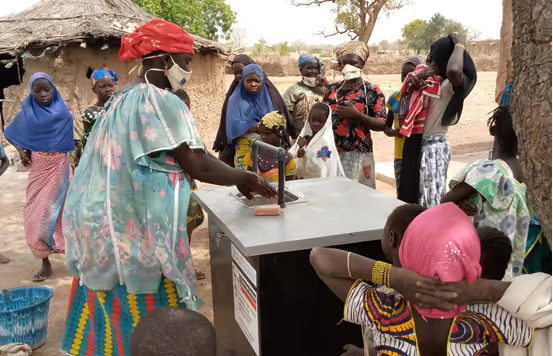
This study adapted and evaluated the effectiveness and implementation of a screening, brief intervention, and referral to treatment stepped care system for Congolese refugees and Zambian host community members in Mantapala.
Project solution
This project offers [specific solution or intervention] to tackle [challenge]. By implementing [strategies, tools, or innovations], the project aims to achieve [desired outcomes]. The approach is designed to [specific actions or methods] to bring about meaningful change in [community, region, or issue area].
Expected outcomes
This project aims to achieve [specific outcomes], such as [measurable results, improvements, or changes]. The expected impact includes [benefits to the target community, advancements in research or innovation, or long-term effects]. By the end of the project, we anticipate [specific changes or milestones] that will contribute to [broader goals or objectives].

Jeremy Kane and Claire Greene
Co-Principal Investigators
Alcohol and other drugs are responsible for substantial physical, psychological, and social harms, including in humanitarian settings. This research will aid us in identifying which interventions are effective for reducing this burden and how we need to adapt services so they are relevant, acceptable, and feasible in humanitarian contexts
Principal Investigators: Jeremy Kane and Claire Greene, Columbia University Mailman School of Public Health
Research Snapshot: Reducing harmful alcohol use in humanitarian settings
In a randomised trial in the Mantapala Refugee Settlement in northern Zambia, a brief alcohol intervention with referral to care (SBIRT) lowered unhealthy alcohol use among adults at 6- and 12- months post-enrolment.
[.cta_link]Read the Snapshot[.cta_link]
What did the study set out to achieve?
Refugees are at risk for unhealthy alcohol and other drug (AOD) use, yet few receive treatment. This research represents the first fully powered trial of an intervention to reduce alcohol-related harms in a humanitarian setting. The study evaluated the effectiveness and implementation of stepped-care AOD services (screening, brief intervention, and referral to evidence-based psychotherapy) for Congolese refugees and host community members in Mantapala, an integrated settlement in northern Zambia.
The study first explored the types, correlates, and patterns of AOD use, validated measures for AOD use, and adapted the intervention and research procedures to be locally relevant and acceptable in the study context. Refugee incentive workers were trained to deliver the intervention to 200 persons reporting unhealthy AOD use. Using a hybrid effectiveness-implementation trial and mixed-methods data collection, the feasibility, cost, barriers and facilitators to implementation of the intervention were evaluated, as well as its effectiveness in reducing unhealthy AOD use and co-occurring mental health problems 12-months after baseline relative to those receiving treatment-as-usual.
The intervention aimed to reduce alcohol and other drug use, improve mental health, and reduce harmful substance-related consequences (e.g., gender-based violence). The study team also anticipated discovering unique considerations for adapting evidence-based interventions to complex humanitarian settings. The research further provided an opportunity to examine the implementation of a public health intervention through an integrated governmental and non-governmental system to both refugees and host community members.
What were the key findings?
- SBIRT was highly effective even among those with very severe symptoms, including those with probable alcohol use disorder.
- Mental health: Improvements in depression/anxiety were evident at 6 months but not sustained at 12 months.
- Feasibility: Uptake and follow-up were strong. 87%completed SBIRT; follow-up remained 76–78% across time points, indicating feasibility in routine services.
- Costs & value for money: Over 28 months, it cost around $84,500 to set up SBIRT and another $136,000 to keep it running, mostly staff costs. SBIRT cost about $158 for each one-point improvement on the AUDIT scale.
What does this mean for policymakers and practitioners?
The findings show that SBIRT is an effective intervention for alcohol use and co-occurring mental health problems in humanitarian settings. The results also suggest that the intervention is effective for individuals with both higher and lower severity problems. Findings also showed it was feasible to train non-specialists to deliver SBIRT while maintaining high quality in a humanitarian setting.
While SBIRT produced meaningful short-term improvements in depression and anxiety, these effects were not sustained at 12months. This may reflect the persistent social and economic stressors facing people in humanitarian contexts, suggesting that psychological interventions alone may be insufficient to maintain gains in mental health over time. For some individuals, additional or ongoing support – such as booster sessions or linkage to livelihood programs – may be needed to address the structural and contextual factors that contribute to poor mental health outcomes.
Although the intervention requires financial investment, it is lower cost than mental health interventions delivered by professional therapists, and there are likely to be downstream positive economic impacts in the community by treating substance use problems, which are highly prevalent in humanitarian contexts.
Project delivery & updates
Stay up to date with the latest developments from this project. Here, you will find details on what has been delivered, resources created, and regular updates as the project progresses. Access key documents, reports, and other materials to see how the project is making an impact.
Resources
Journal article
LEARN MOREJournal article
LEARN MOREJournal article
LEARN MORE