


2025 in review: challenges, achievements and what comes next



It’s no stretch to say that 2025 was one of the most difficult years on record for the humanitarian community. Global funding fell to a decade-long low, while the number of people living through crises, facing displacement and experiencing food insecurity reached at an all-time high. Prioritisation became not just a watchword but a necessity.
For Elrha, 2025 marked a new chapter as we welcomed Kate Maina-Vorley as CEO. Her appointment brought both continuity and renewal – an opportunity to reflect and redefine how we work, while reinforcing our commitment to strengthening humanitarian research and innovation at a moment when evidence-led decision-making is more critical than ever.
2025 also brought us towards the culmination of our current six-year phase of work through our programmes; the Humanitarian Innovation Fund (HIF) and Research for Health in Humanitarian Crises (R2HC). And, after five years hosting the UK Humanitarian Innovation Hub (UKHIH), we took the first steps towards integrating the UKHIH into Elrha.
But like many in the sector, we also faced the reality of reduced funding. What started as a gradual evolution of our work - the drive to stay relevant, agile and valuable to humanitarians and the communities they serve - now carries the weight of loss.
Over the past 16 years, humanitarian research and innovation have transformed how the sector responds to crises – improving the speed, quality, and accountability of aid. We have been privileged to play a leading role in that transformation. Through both our programmes, and the UKHIH, we’ve helped identify, fund, and scale solutions that have improved health outcomes, influenced policy, and changed practice across dozens of contexts. Our work has connected evidence with action – turning promising ideas into real-world impact, improving lives in crises across the world.
2026 will bring significant change to Elrha. As we navigate this, we are holding two truths: optimism for what lies ahead, and sadness at saying goodbye to colleagues and friends who have shaped our journey. Over the coming months, we will be unifying our existing programmes, including the integration of the UKHIH, bringing research and innovation closer together to build a more coherent organisation that maximises our impact, and simplifies our structure, making it easier for partners to engage with us – and with each other – to deliver better for the sector and those affected by crises.
While these changes lie ahead, it’s important we also take the time to reflect on a few achievements and highlights from the last 12 months, in partnership and solidarity with the humanitarian community:
Focusing our funding to meet emerging and priority needs
Supporting menstrual hygiene management in Gaza and Lebanon
Funded through our ‘Adopting Innovations in a Rapid Onset Crisis’ challenge, Reemi and Oxfam built on earlier pilots of innovative menstrual hygiene products designed to support dignity, privacy and health in emergencies. In 2025, they achieved large-scale humanitarian distribution despite extreme access constraints. Between January and May, nearly 5,000 Reemi MHM kits were delivered to women and girls in Gaza, following months of border delays and conflict-related disruptions. When access to Gaza became uncertain, the partnership adapted, distributing a further 2000 kits in Lebanon in April. This reached Lebanese, Palestinian and Syrian women and demonstrating how funded innovations can be scaled in rapid-onset crises.
Responding to the mpox outbreak in the Democratic Republic of Congo and beyond
When mpox was declared a Public Health Emergency of International Concern (PHEIC), particularly across Central Africa, our scoping of key research and innovation needs identified social and behavioural science (SBS) as a critical gap. In 2025 we funded three projects aimed at strengthening SBS within the mpox response, including exploration of vaccine acceptability and uptake among at-risk communities, understanding patient experiences in one of Kinshasa’s poorest neighbourhoods, and bolstering the existing evidence base for mpox across Africa.
Identifying innovations for cardiometabolic disease care in Sub-Saharan Africa
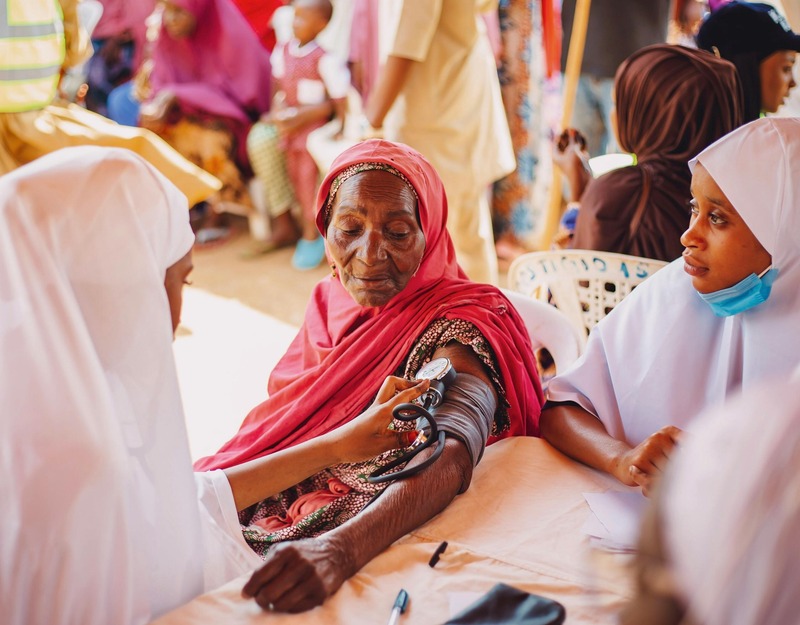
This year, we explored a new area of work to identify and promote locally developed innovations for the prevention and management of cardiometabolic diseases (CMDs) in humanitarian settings. Supported by the Novo Nordisk Foundation, this project addresses critical evidence gaps for CMD management and prevention across sub-Saharan Africa. By building a stronger evidence base, we can support better decision-making among health actors, inform global practice, and drive commitments from funders and implementers to scale up what works.
AI learning journey
Our AI for Humanitarians work launched in 2023 to support the ethical and responsible use of artificial intelligence among humanitarian innovators and agencies. With the learning journey now complete, teams have shared their reflections on the possibilities of AI for humanitarian response, their experiences, and the considerations for NGOs and humanitarian agencies looking to adopt the technology. Our dedicated newsletter on all things humanitarian AI will now be paused but you can explore past issues in the archive. You can also listen back to our podcast series in collaboration with NetHope here
Equipping the sector with knowledge, skills and insights
Evidence from the frontline: mental health in crisis affected contexts
MHPSS is critical in humanitarian settings, yet evidence-informed practices don’t always reach the field. Our podcast series aimed to close that gap. Created in collaboration with the Red Cross Red Crescent Movement MHPSS Hub it shares practical insights from innovators, implementers and technical experts, and research-backed interventions tailored to humanitarian, refugee and crisis-affected contexts.
Advancing Holistic Efforts Against Undernutrition in Crises - interactive tool
We launched our new undernutrition tool, which complements the Advancing Holistic Efforts Against Undernutrition in Crises (AHEAd) decision-making tool and resource package introduced last year. This decision tool and resource package will support governments, donors and coordinating and implementing agencies working in food insecure humanitarian contexts, to design and deliver an effective response for the prevention of undernutrition among pregnant and breastfeeding women and adolescent girls (PBWGs) and children under five years. It aims to support multisectoral response, delivered by multiple actors, to address the most common and immediate drivers of undernutrition across diverse humanitarian settings.
Gender-based violence (GBV) insights
Since 2015, we have funded and championed humanitarian innovation which specifically addresses GBV in emergencies. We’ve produced analysis of opportunities for innovation and of persistent gaps, based on a global consultation, and have funded over 50 projects related to humanitarian research and innovation. This new interview series shares insights from our current and past grantees, and other members of the GBV community, on what innovation has contributed to best practices and what could or should be on the horizon.
Sexual and reproductive health and rights (SRHR) priority setting
We know that SRHR is fundamental to wellbeing, dignity and equality. Yet, access to care, support and services is often severely compromised during humanitarian crises. Our recent prioritisation study provided an updated and actionable set of implementation research priorities to strengthen SRHR outcomes in humanitarian settings, spanning the nine SRHR domains and six World Bank geographic regions. This agenda is designed as a navigation tool for donors, governments, implementers and researchers to identify high-priority, practice-relevant research questions in SRHR in humanitarian settings.
Research and innovation priorities for adapting humanitarian WASH to climate change
We partnered with Oxfam and the ADAPT Initiative to better understand how climate change is transforming and affecting humanitarian WASH systems. This report explores the findings from an extensive global consultation, identifying critical research and innovation opportunities to strengthen systems against climate challenges. It draws on comprehensive literature reviews, insights from practitioners worldwide and data from nine countries affected by crisis, generating 11 actionable priorities.
Engaging with the humanitarian community to address shared challenges and opportunities
Humanitarian Innovation Forum
In February, our Humanitarian Innovation Forum brought together a diverse group of innovators, decision-makers and funders to tackle some of the most pressing humanitarian challenges facing the world today. Over three days in Nairobi, Kenya, we explored not just what we innovate, but how and why, developing shared ambitions, testing ideas and forging lasting connections. Against the backdrop of growing global funding challenges, these discussions felt more urgent than ever. Through deep engagement and a commitment to practical outcomes, the Forum laid the foundation for a collective movement to strengthen humanitarian innovation systems and ensure innovation delivers real impact for people affected by crises. This conversation continues in our two upcoming webinars which build on themes from the Forum.
Humanitarian Health Research Forum
In May, we returned to Nairobi for our Humanitarian Health Research Forum, alongside more than 150 researchers, practitioners, funders, policymakers, and community leaders. Co-hosted with the African Population and Health Research Center (APHRC), the vibrant event was a platform for reflection, collaboration, and bold thinking on the future of humanitarian health research. The Forum addressed urgent questions facing the sector, sparking vital conversations on climate change, local leadership, and how research can be transformed into timely, trusted and impactful action. With thought-provoking speakers, panel conversations and practical workshops, the Forum fostered fresh collaboration, challenged the status quo and provided a pathway for more inclusive and effective humanitarian research ecosystems. Revisit key discussions by exploring resources from the Forum to deepen your understanding and apply the insights to your work.
Her Health, Our Future: Abortion Policy Brief
In November we published ‘Her Health, Our Future’, an evidence-based policy brief calling for comprehensive abortion care to be treated as essential, life-saving healthcare in humanitarian crises. It sets out the scale of need and shows that safe care is feasible even in constrained contexts. The brief draws on research and field-tested innovations to highlight practical options, including self-managed abortion support, community-based distribution and rapid training, and provides clear recommendations for governments, donors, UN agencies and NGOs. We launched the policy brief at the 2025 International Conference on Family Planning (ICFP), in Bogotá, Colombia. It was an opportunity to share learning from our work and the work of our partners, and to explore how humanitarian research and innovation can support and promote better SRHR services, education and outcomes for people affected by crisis.
UK Humanitarian Innovation Hub (UKHIH)
UKHIH’s work in 2025 demonstrated how timely, credible analysis and adaptive learning can support decision-making in some of the most complex humanitarian contexts.
Scenario-based mortality and nutrition projections (Gaza and Sudan)
In 2025, scenario-based mortality projections for Gaza were delivered under three conflict trajectories – ceasefire, status quo and escalation – and were widely cited, demonstrating the operational value of credible forecasting in highly contested settings. Building on this approach, the Sudan AMBER project adapted the framework to project malnutrition outcomes in besieged areas where surveys were impossible. It produced the first nutrition projections for Sudan, highlighting both catastrophic risk and the protective impact of community kitchens. Together, these initiatives strengthened preparedness, advocacy and evidence-led decision-making.
Adaptive learning for humanitarians (Somalia and Sudan)
The UKHIH partnered with the Centre for Humanitarian Change to advance adaptive learning in Somalia, focusing on how tacit, experience-based knowledge can be captured and used to improve real-time humanitarian decision-making. Through workshops and structured sessions , the project addressed persistent barriers to collaboration and learning in complex operational contexts. Findings were synthesised into a novel storyboard using accessible and engaging formats. This work laid the foundation for a second phase, expanding to Somalia and Sudan, with a new emphasis on area-based coordination and locally led learning systems.
Responsive Fund – Syria
Through the Responsive Fund, two major Syria projects delivered practical analytical innovations. The Syria Area-Based Analysis (SABA) Dashboard integrated multi-sectoral data at sub-district level to support prioritisation and strategic dialogue in a fragmented operational environment and is now widely used by humanitarian actors. Mercy Corps’ CROP-ID project combined satellite imagery and machine learning to generate high-resolution agricultural intelligence, producing geospatial products for the 2024–25 season that improve visibility of crop patterns, water demand and vulnerabilities, supporting more targeted and timely food security and climate responses.
Stay updated
Sign up for our newsletter to receive regular updates on resources, news, and insights like this. Don’t miss out on important information that can help you stay informed and engaged.



Explore Elrha
Learn more about our mission, the organisations we support, and the resources we provide to drive research and innovation in humanitarian response.