


Implementation of a community-led strategy to reduce cardiovascular disease risk among conflict-affected populations in eastern Myanmar

Project overview
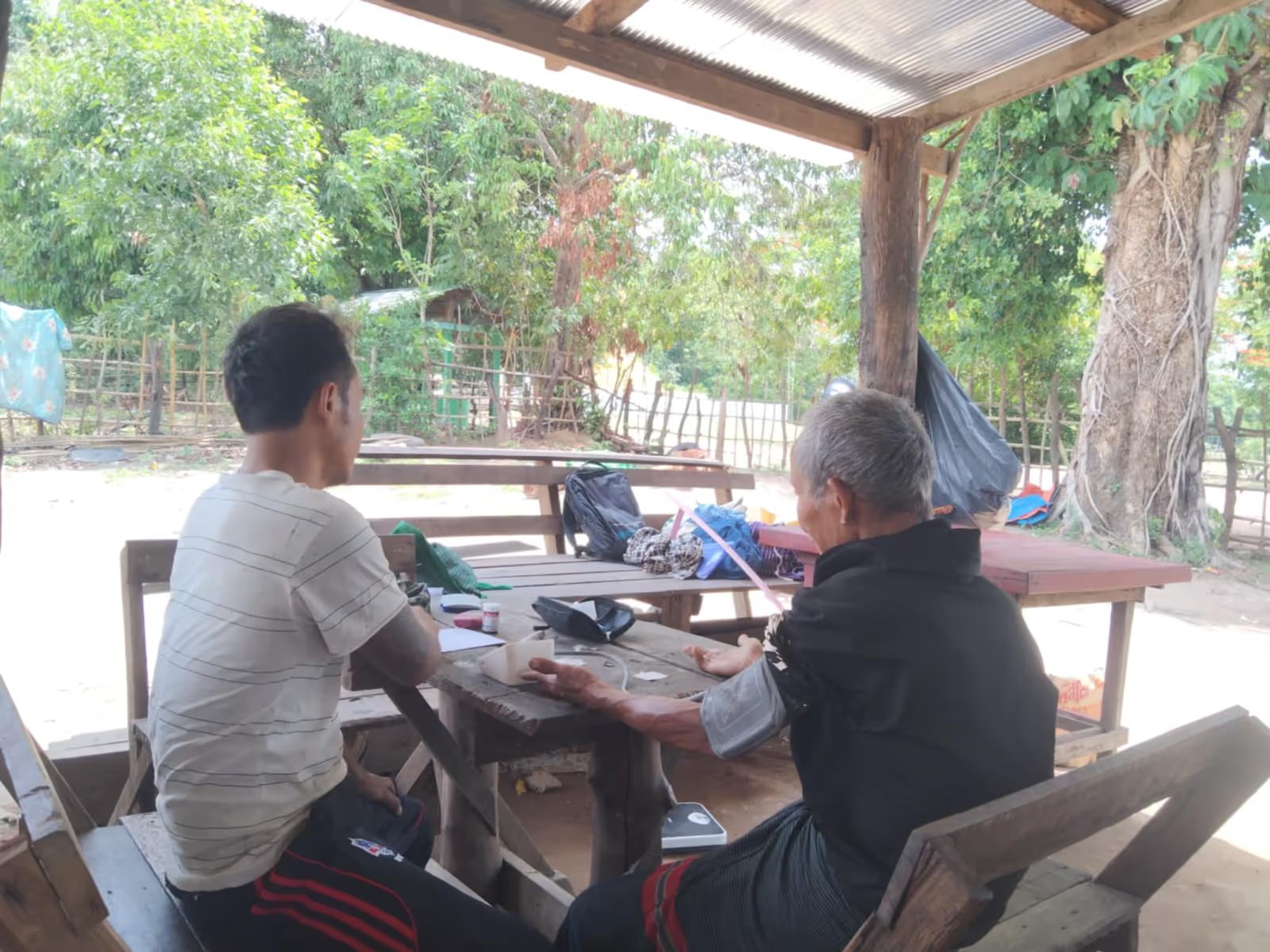
This research demonstrated the effectiveness, feasibility, adaptability, and resilience of a Village Health Worker (VHW) care model for cardiovascular disease risk reduction, in the active conflict setting of Myanmar.
Project solution
This project offers [specific solution or intervention] to tackle [challenge]. By implementing [strategies, tools, or innovations], the project aims to achieve [desired outcomes]. The approach is designed to [specific actions or methods] to bring about meaningful change in [community, region, or issue area].
Expected outcomes
This project aims to achieve [specific outcomes], such as [measurable results, improvements, or changes]. The expected impact includes [benefits to the target community, advancements in research or innovation, or long-term effects]. By the end of the project, we anticipate [specific changes or milestones] that will contribute to [broader goals or objectives].
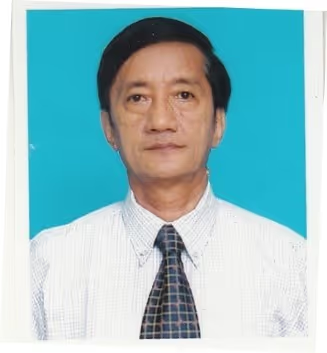
Dr. Than Tun Sein
CPI
In an area with high CVD risks, the study is highly important for the ethnic people in conflict situation where CVD risk reduction through volunteer workers would be implemented and tested , from epidemiology as well as equity perspectives.
Principal Investigators: Parveen Parmar, MD, MPH (University of Southern California), Adam Richards, MD, MPH, PhD (George Washington University)
Research Snapshot: Preventing heart disease and stroke during conflict
This research demonstrated the effectiveness, feasibility, adaptability, and resilience of a Village Health Worker (VHW) care model for cardiovascular disease risk reduction, in the active conflict setting of Myanmar.
[.cta_link]Read the snapshot[.cta_link]
What did the study set out to achieve?
Cardiovascular disease (CVD) such as stroke and heart attack is the leading cause of death in Myanmar and in many fragile and conflict-affected states. However, coverage of evidence-based treatments is low. Community health worker (CHW)-led care models have been shown to reduce CVD risk in politically stable settings, but studies are lacking that demonstrate the effectiveness and efficiency of CHW-led care models in humanitarian emergencies.
A VHW-led strategy for CVD prevention was developed by participatory design. Feasibility and acceptability were tested, then a cluster randomised controlled trial (involving 1,013 adults from 13 villages) tested the effectiveness of the model over an eight-month period. Qualitative interviews explored implementation barriers and facilitators. Intervention impacts and costs were modelled using population survey data.
What were the key findings?
A decentralised VHW–led care model dramatically improved medication adherence and blood pressure control and reduced cardiovascular disease risk in conflict-affected Myanmar, at low cost. The care model (comprising screening, diagnosis visit, medication decisions assisted by tablet computers, and monthly follow-up) effectively and efficiently delivered chronic disease care, even during acute displacement from aerial attack. Findings suggest that humanitarian actors involved in health service delivery should consider integrating and scaling similar VHW-led care models to address the high burden of NCDs in other humanitarian settings.
- Medication adherence improved dramatically under the VHW care model. Starting from an 8% baseline, 92% of patients were adherent by the end of the trial, compared with just 16% in control communities.
- The care model also lowered average systolic blood pressure significantly - 18.7 mmHg more in intervention villages vs. control villages.
- From the healthcare sector perspective, the VHW care model gives good value for money. It costs about $1,579 to gain one extra year of healthy life, much cheaper than the usual benchmark for what is considered worth paying in Myanmar ($2,718).
- Those interviewed valued home-based follow-up that virtually eliminates the need for costly, risky travel for facility care. They believe the intervention is scalable.
- VHWs provided continuous care for 12 participants whose village was destroyed by airstrikes during the trial. This suggests a decentralised VHW-led model may enable care continuity following acute forced displacement due to armed conflict.
What does this mean for policymakers and practitioners?
The findings suggest that a decentralised VHW care model can effectively and efficiently achieve high coverage of evidence-based care for noncommunicable diseases (NCDs) in remote rural areas experiencing active armed conflict. The VHW-led approach had tangible impacts on medication adherence and blood pressure. This has real significance for public health: if someone eligible for statin therapy to lower CVD risk had a systolic blood pressure of 150 mmHg, a reduction of 18.7 mmHg (as achieved in Myanmar) would bring them down to about 131 mmHg; if they also took a statin they would greatly reduce their risk of heart attack and stroke. Since the approach was also very good value for money, humanitarian actors involved in health service delivery should consider integrating and scaling similar VHW-led care models to address the high burden of NCDs in other humanitarian settings.
Policymakers and implementing agencies should invest in capacity building of human resources for NCD care, support cross-border mechanisms and commit financial resources to sustain and expand VHW-led care for displaced Myanmar populations.
Project delivery & updates
Stay up to date with the latest developments from this project. Here, you will find details on what has been delivered, resources created, and regular updates as the project progresses. Access key documents, reports, and other materials to see how the project is making an impact.
Resources
Journal article
LEARN MOREJournal article
LEARN MORE