


Improving the control of measles epidemics in Niger through a combination of anticipatory and real-time tools
.jpg)

Project overview
The ‘Anticipate Measles’ project brought together researchers and operational actors to develop data driven tools to improve rapid outbreak detection and orient effective response.
Countries
Niger
Organisations
Epicentre
Partners
London School of Hygiene & Tropical Medicine, Ministère de la Santé Publique, de la Population et des Affaires Sociales du Niger
Area of funding
Humanitarian Research
Grant amount
£321,650
Start date
01
April
2023
End date
01
June
2025
Project length (in months)
26
Funding calls
Focus areas
No items found.
Topics
No items found.
Status
Closed
Project solution
This project offers [specific solution or intervention] to tackle [challenge]. By implementing [strategies, tools, or innovations], the project aims to achieve [desired outcomes]. The approach is designed to [specific actions or methods] to bring about meaningful change in [community, region, or issue area].
Expected outcomes
This project aims to achieve [specific outcomes], such as [measurable results, improvements, or changes]. The expected impact includes [benefits to the target community, advancements in research or innovation, or long-term effects]. By the end of the project, we anticipate [specific changes or milestones] that will contribute to [broader goals or objectives].
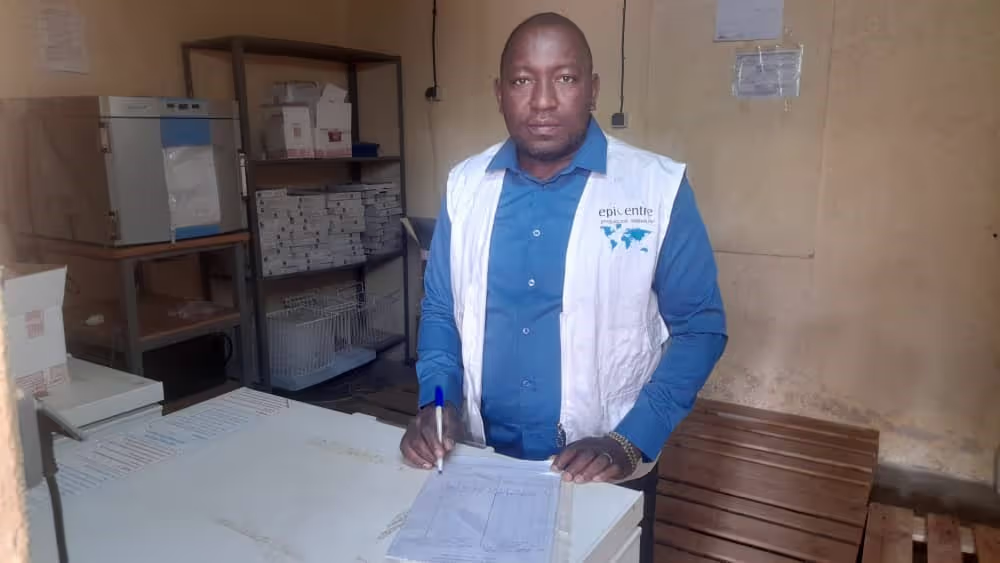
Abdoul-Aziz Idrissa
Epicentre Niger
At present, the effectiveness of measles control in Niger is heavily undercut by the absence of risk-based allocation and strategy. Our research project should support data-driven decision making for measles outbreaks. We hope to demonstrate the added value of these methods over those that use surveillance data alone.
Principal Investigators: Dr. Anton Camacho, Dr Ousmane Guindo
Research Snapshot: Measles in Niger: who will be sick tomorrow?
This study in Niger developed and validated an early warning alert system and a forecasting tool to better anticipate and interpret measles outbreaks, generating insights and positioning the tools for operational decision-making in future outbreaks.
[.cta_link]Read the Snapshot[.cta_link]
What did the study set out to achieve?
Measles contributes heavily to childhood mortality and morbidity in humanitarian settings, and rapid outbreak containment is critical. Niger faces an annual measles season. While its timing is relatively consistent, the size and location of hotspots varies, making it difficult to plan health responses. Emergency campaigns are relied upon, but their impact is easily compromised by delays in outbreak detection and resource mobilization. While prediction methods for measles have been developed elsewhere, these techniques have yet to be validated in a low resource setting.
Three types of tools were developed and evaluated against retrospective data:
- Maps of outbreak risk to inform proactive vaccine allocation;
- A simple alert system to improve early detection of outbreaks;
- Forecasting tools to interpret epidemic trends and inform response prioritization.
What were the key findings?
- While risk maps were unreliable, likely due to data quality/availability issues, the alert system and forecasting tools proved operationally promising.
- The final warning system generates district-level alerts with Level 1 or 2 indicating how likely it is that a current trend in cases will turn into an full on outbreak (64% chance for Level 1 and 95% for Level 2); these alerts prove more reliable compared to existing systems, which are prone to false alerts.
- If followed by response within 4 weeks, Level 1 Alerts may help interventions to treat or offset 73% of cases (60% for Level 2).
- The final forecasting tools assess which alerted outbreaks are nearing their peak with 65% accuracy for Level 1 Alerts and 75% for Level 2; they also identify which outbreaks will have 100 or more additional cases (74% accurate for Level 1 and 84% for Level 2).
- Ultimately, simple models/approaches proved equally or more robust than complex ones when applied to a data frail humanitarian context.
What does this mean for policymakers and practitioners?
‘Anticipate Measles’ built data driven tools adapted to a humanitarian context. Building such tools is challenging--complicated by issues of extreme data frailty and pragmatic constraints.
The alert and forecasting tools have been integrated into an online dashboard used by the Ministry of Health and Médecins sans Frontières for operational decision making. Local actors have been given multiple trainings on the dashboard, the warning system, and the forecasting tools so that they can be used confidently during future measles seasons.
Ultimately, the team found that the complex approaches and research questions frequently used in the Global North may be poorly adapted to the pragmatic realities and data limitations of humanitarian contexts. Finding solutions demanded flexibility and close collaboration with local actors to identify "sweet spot" questions that are both operationally useful and feasible to answer. For example, while it is unrealistic to answer "exactly when will this epidemic peak?", we can respond to "is the peak at least 4 weeks away"--which ends up being enough information to determine whether teams still have time to run a vaccination campaign before the outbreak starts to slow down on its own.
No items found.
Project delivery & updates
Stay up to date with the latest developments from this project. Here, you will find details on what has been delivered, resources created, and regular updates as the project progresses. Access key documents, reports, and other materials to see how the project is making an impact.
No resources/updates have been published yet for this project. Sign up for our newsletter to stay informed about upcoming publications and updates!
Join our Newsletter
Latest updates
No items found.