


Saving 87 Million lives starts with counting lives lost


This blog series accompanies the Mortality Estimation Systems Innovation Partnership (SIP), supported by UKHIH–Elrha, which brings together diverse partners to strengthen how mortality data is collected, understood, and used to inform humanitarian decision-making.
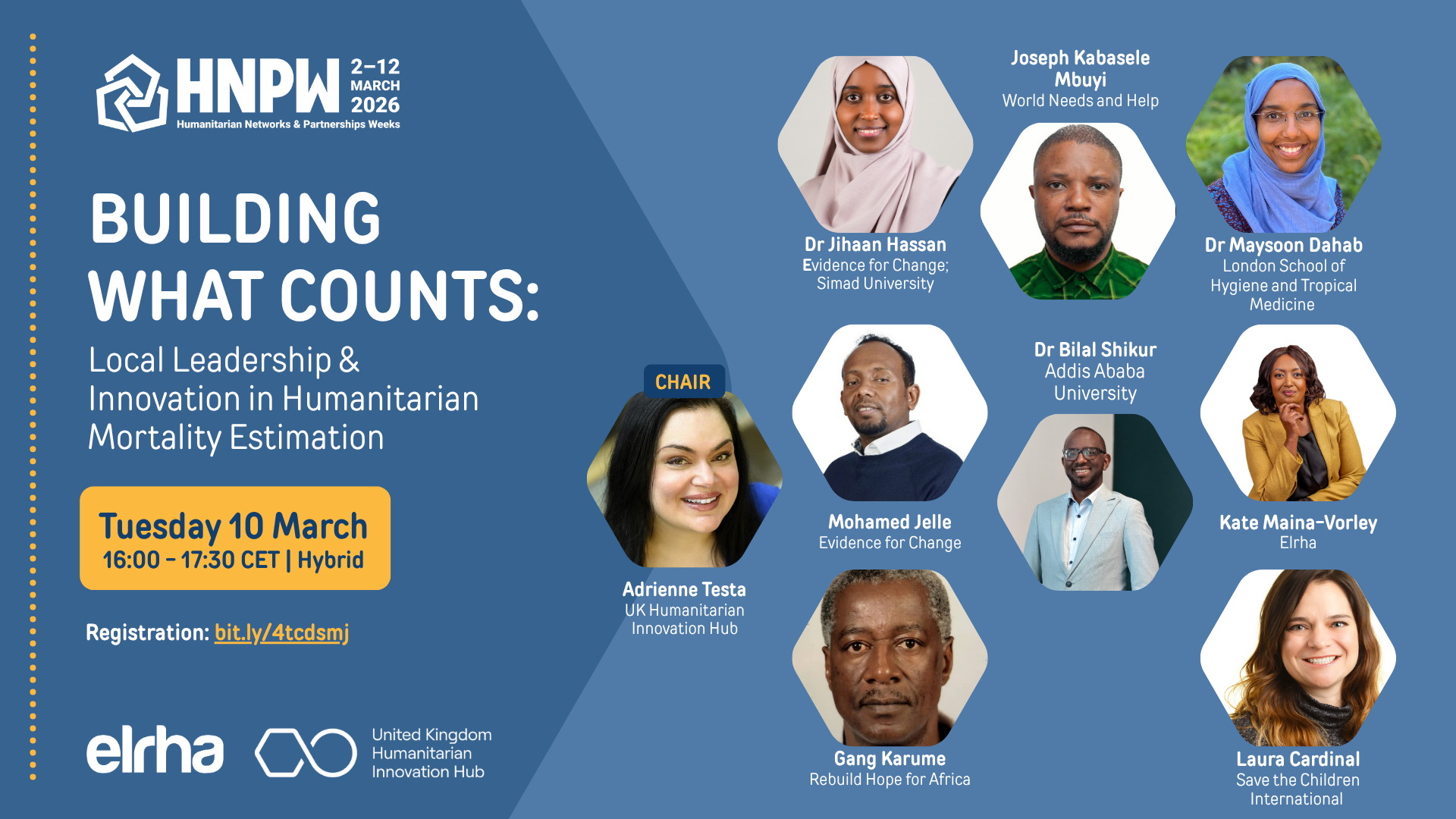
This blog draws on the session Building What Counts: Local Leadership & Innovation in the Humanitarian Mortality Estimation, convened at the Humanitarian Networks and Partnerships Week 2026, Geneva, by the UK Humanitarian Innovation Hub and Elrha.
The morning after our session on Mortality Estimation in Crises at HNPW 2026, UN Relief Chief Tom Fletcher took the stage and declared a plan to save 87 million lives. It is an ambitious and necessary vision. But one that nonetheless reanimated a question that had consumed the room the day before: how will we know how many lives are saved, if we cannot measure how many died?
That tension sits at the heart of what our session explored. In a field defined by the imperative to save lives, the humanitarian sector has a striking blind spot: it rarely knows how many people are dying. We count displacement, malnutrition rates, and funding gaps. But the most fundamental indicator - deaths - routinely goes unmeasured.
"What isn't counted, too often does not count. The omission is not just a data gap - it's a moral failure that hits hardest on communities who are simultaneously closest to the crisis and furthest from the decisions over how it is responded to."
Adrienne Testa, UK Humanitarian Innovation Hub-Elrha
The smoke alarm was not turned on
Dr. Bilal Shikur of Addis Ababa University described mortality data as a smoke alarm. If it isn't ringing in real time, the house burns before anyone knows there's a fire. The 25-year mortality surveillance programme produced data that reshaped Ethiopia's national health priorities, and during COVID-19 became the only credible real-time source for ministerial decisions. Today it is inactive - rooms empty, papers locked away, funding gone.
"The biggest challenge we face is not a lack of local skill. We have local expertise and experience. The real problem is that mortality estimation has never been treated as a true system priority. When something is not a priority, it doesn't receive sustainable financing."
Dr. Bilal Shikur, Addis Ababa University, Ethiopia
Local actors are not a mere method - they are the architects
In Somalia, Mohamed Jelle of Evidence for Change (E4C) led the implementation of the Nutrition and Mortality Surveillance - which collected data across five regions every six weeks during the 2022–23 drought, feeding directly into cluster decision-making. The lesson from 2011, when a quarter of a million people died in a famine that the world was slow to see, is that data is arriving too late saves no one.
"Why local actors? Because we have the knowledge, we have the experience, we are embedded in communities. We are the community."
Mohamed Jelle, Evidence for Change, Kenya & Somalia
Dr. Jihaan Hassan of SIMAD University took this further, exploring how to collect mortality data in locations to which even local organisations cannot safely go. Working with burial attendants - gravediggers, body washers, and religious leaders - her team found communities already present at every death, willing to record them as an extension of their duty to protect the living:
"Previously we buried people based on brotherhood and charity - now we hope we can also collect data, because we saw the value of having this data inform humanitarian decision-making."
Burial attendant participant, Somalia - shared by Dr. Jihaan Hassan, SIMAD University & Evidence for Change
Joseph Kabasele Mbuyi from World Needs & Help collected mortality data in the Masisi territory of DRC where conflict and damage to the health infrastructure have triggered a domino effect, cutting off access to care and leading to excess deaths. He noted that in this highly sensitive environment, shared language, shared customs, and a shared reality allows local actors to gather mortality data with the patience and empathy required.
Gang Karume of Rebuild Hope for Africa, led a nationwide mortality survey in the Central African Republic, found that the country had lost up to 5% of its population in a year despite a significant UN presence. The government tried to have the findings withdrawn. The data existed. The credibility existed. What failed was the system's willingness to act on it.
"If you don't have good data, you don't have an argument to push people to act. You don't measure - you have people who are left abandoned…we can’t keep quiet, because one day we might be the ones who need to be counted."
Gang Karume, Rebuild Hope for Africa, DRC
Power shifting is not task shifting
A funder's perspective on ensuring localisation came from Elrha CEO Kate Maina-Vorley, who named what the sector rarely admits openly:
"The real data collection in Somalia, DRC, and Ethiopia is being done by national research institutions, local universities, and community-based organisations. They are often at the end of a long funding chain, receiving just a fraction of the original grant - with very limited flexibility and very short time horizons. That is not localisation by any means. This is subcontracting with a different label."
Kate Maina-Vorley, Elrha
This critique lands harder in the context of the broader humanitarian reset, where calls to shift power to local actors have multiplied even as financing architecture has barely moved. Dr. Maysoon Dahab of the Sudan Research Group at LSHTM sharpened the distinction further:
“Power shifting is not the same as task shifting…where all the risk is borne by community members, with very limited long-term engagement and support…which is really important, because often you ask people to share the most difficult, the most vulnerable, the most risky parts of their lives, which is the names and details of their loved ones.”
Dr Maysoon Dahab, Sudan Research Group, LSHTM
The solution is not only about funding flows. It is about who controls the evidence. Laura Cardinal of Save the Children International’s Mortality Estimation Initiative put it plainly:
"If we strengthen national statistical systems and locally-led action through national partners, it can build a more sustainable and accountable mortality monitoring system over time."
Laura Cardinal, Save the Children International
Distributed ownership of mortality data - across local institutions, national governments, and communities themselves - is both an equity principle and a safeguard. When evidence is co-produced and locally anchored, it is harder to suppress, harder to dismiss, and more likely to reach decision-makers in time to matter.
Measuring lives lost is not optional
If we are to save 87 million lives this year, we must first demand an answer to how we will know if we’ve succeeded. Mortality estimation is that answer: the clearest measure of whether a response is actually working.
The knowledge already exists in crisis-affected communities. The capacity already exists in national universities, civil society organisations, and public health departments in Addis Ababa, Tigray, Nairobi, Bukavu, Goma, and Mogadishu. What has consistently failed is the system's willingness to resource, trust, and sustain this fundamental activity.
The humanitarian reset offers a genuine opportunity to act on this wealth of expertise. But only if the localisation of financing keeps pace with localisation of work, and if the sector finally treats counting deaths not as a difficult truth to manage, but as the non-negotiable foundation of claiming to save lives.
Stay updated
Sign up for our newsletter to receive regular updates on resources, news, and insights like this. Don’t miss out on important information that can help you stay informed and engaged.



Explore Elrha
Learn more about our mission, the organisations we support, and the resources we provide to drive research and innovation in humanitarian response.