ELRHA's research matching facility: successful case study
Last year ELRHA was contacted by the Emergency Capacity Building (ECB) Project via our Research Matching Facility looking for academic partners to collaborate on developing a ‘Good Enough Guide’ for Humanitarian Impact Measurement in Rapid Onset Emergencies.
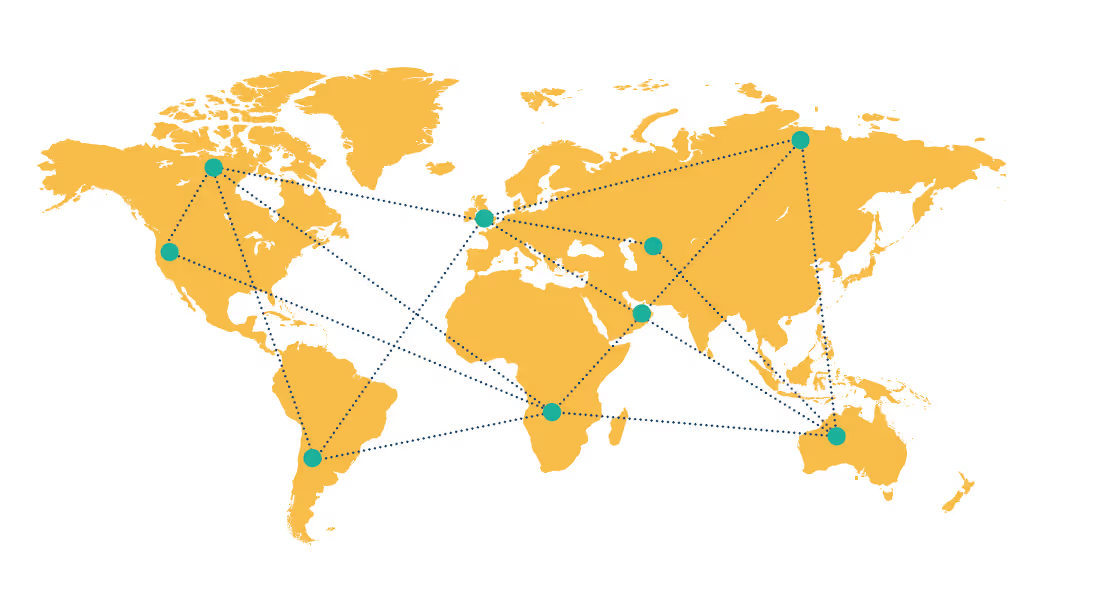
ELRHA’s Research Matching Facility is the first facility that offers humanitarian agencies and higher education institutions the opportunity to search or advertise for research and project partners. In this case we put ECB in contact with the School of International Development at University of East Anglia.
Collaborative Partnership: Developing a ‘Good Enough Guide’ for Humanitarian Impact Measurement in Rapid Onset Emergencies
How can humanitarian actors determine if their activities in the field have an impact? This simple question remains one of the fundamental challenges facing humanitarian actors working in sudden onset emergencies. While a range of tools exist to measure impact in development contexts, the unique settings and operational imperatives of most humanitarian situations have, thus far, prevented the adoption of rigorous approaches to measurement of the outcomes in sudden onset emergencies.
One of the key constraints to measuring impact is identifying a baseline from which progress can be measured. Another lies in the problem of attribution, how to isolate the impacts of a particular intervention from the many other causal factors contributing to change in rapidly evolving situations. Ethical, security and operational issues usually take precedence over rigorous evaluation. Many aid workers lack either the time or specific skills to collect good quality data. It is therefore not surprising that most reporting focuses on outputs – the number of people fed, children immunised, school books delivered, or shelters provided – rather than impacts - the lasting effects on peoples’ lives of the intervention as a whole.
This collaborative project intends to research, pilot and develop a Good Enough approach and supporting tools for the measurement of the impact of aid agencies’ programmes in response to rapid onset emergencies.
The aim of the project is to develop a framework that will enable the measurement of change brought about by humanitarian interventions. The key priority is to create something that is both credible and usable. ECB’s ‘field first’ approach will be adopted to develop and pilot methodologies and tools in partnership with ECB members. The timeframe for the project is two years and the main outcome will be the preparation of a ‘Good Enough Guide to Impact Measurement’ modelled on the ECB’s popular ‘Good Enough Guide to Accountability’.
Examples of Impact Measurement from the field are welcome!
We would welcome any examples from the field regarding what has worked and what has not worked, in terms of trying to measure the impact of humanitarian interventions. The research team consists of Dr Roger Few, Dr Marcela Tarazona and Mr Daniel McAvoy, from the School of International Development at UEA, and Dr Vivien Walden from Oxfam, representing the ECB stakeholders. Ms Catherine Gould (Oxfam) is coordinating the research project. Please contact Catherine Gould on cgould@oxfam.org.uk to share examples or for further information about the research.
Emergency Capacity Building Project
ECB is a five year capacity building project. It involves six of the major INGOs, although works through many more organisations at the country level where its five consortia have a varied ‘membership’. These five consortia are based in Bolivia, Indonesia, Bangladesh, Niger, and the Horn of Africa. For more information see: http://www.ecbproject.org
School of International Development at the University of East Anglia
The School is a globally-renowned centre of excellence for teaching and research in International Development. Established in 1973 the School, called ‘DEV’, was one of the first university departments in the world to offer degrees in international development and remains one of the few to offer such a wide variety of subjects at undergraduate, postgraduate and PhD level. We have a unique partnership with International Development UEA (previously called the Overseas Development Group), a charitable company which pioneered research, training and consultancy in international development. For more information see: http://www.uea.ac.uk/dev